
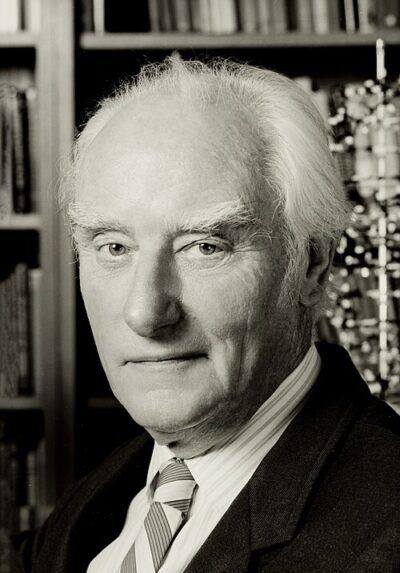
Francis Crick
Francis Crick was a British molecular biologist, biophysicist, neuroscientist; co-discoverer of the structure of DNA. Born June 8, 1916, in Northampton. Died July 28, 2004, in La Jolla. Known for Life Itself: Its Origin and Nature. Educated at University College London and Gonville and Caius College. Awards include Fellow of the Royal Society, Albert Lasker Award for Basic Medical Research and Nobel Prize in Physiology or Medicine.
Facts
54 facts · 2 confirmed by two sources · 43 cited · 9 from one source
Where this comes from
Papalocal keeps its own record. It started from these sources; what each one said is kept here as it was copied, so a change on their side never changes this page by itself. Tap one to read its version.
What Wikidata says · copied November 16, 2026 · revision 2566476400
- Described as
- British molecular biologist, biophysicist, neuroscientist; co-discoverer of the structure of DNA (1916–2004)
- Other names
- Francis Harry Compton Crick, Francis H.C. Crick
- Born
- June 8, 1916 · 10 references
- Died
- July 28, 2004 · 9 references
- Born in
- Northampton · 2 references
- Died in
- La Jolla · 1 reference
- Buried in
- Pacific Ocean
- Cause of death
- colorectal cancer · 1 reference
- Citizen of
- United Kingdom · 1 reference
- Occupation
- biologist · 1 reference; geneticist · 1 reference; physicist · 1 reference; neuroscientist · 1 reference; biochemist · 1 reference; molecular biologist · 1 reference; university teacher · 1 reference; biophysicist · 1 reference
- Worked for
- University of Cambridge · 1 reference; Salk Institute for Biological Studies · 1 reference; New York University Tandon School of Engineering · 1 reference
- Education
- University College London · 1 reference; Gonville and Caius College · 1 reference; Mill Hill School · 1 reference; University of Cambridge · 1 reference; Northampton School for Boys
- Member of
- Royal Society of London · 1 reference; German Academy of Sciences Leopoldina · 1 reference; French Academy of Sciences · 1 reference; American Academy of Arts and Sciences · 1 reference; European Molecular Biology Organization · 1 reference; National Academy of Sciences (1969–); American Philosophical Society (1972–)
- Known for
- Life Itself: Its Origin and Nature
- Awards
- Fellow of the Royal Society · 1 reference; Albert Lasker Award for Basic Medical Research (1960) · 2 references; Nobel Prize in Physiology or Medicine (1962) · 3 references; Order of Merit · 1 reference; Copley Medal (1975) · 2 references; Royal Medal (1972) · 1 reference; Philadelphia Liberty Medal · 1 reference; Canada Gairdner International Award (1962) · 1 reference; EMBO Membership · 1 reference; Grand Prix Charles-Leopold Mayer (1961) · 1 reference; Sir Hans Krebs Medal (1977) · 1 reference; Albert Medal (1987) · 1 reference; Croonian Medal and Lecture (1966) · 1 reference; Fellow of the Committee for Skeptical Inquiry; Mendel Medal (1966) · 1 reference
- Field
- molecular biology · 1 reference; deoxyribonucleic acid · 1 reference; physics · 1 reference; neuroscience · 1 reference; biophysics · 1 reference; genetics · 1 reference
- Spouse
- Odile Crick
- Religion
- atheism
- Wikipedias with a page
- 97
Wikidata item Q123280 (wikidata.org/wiki/Q123280), public domain (CC0). Copied November 16, 2026.
What Wikipedia says · copied November 16, 2026 · revision 1385542979
Francis Harry Compton Crick (8 June 1916 – 28 July 2004) was an English molecular biologist, biophysicist, and neuroscientist. He, James Watson, Rosalind Franklin, and Maurice Wilkins played crucial roles in deciphering the helical structure of the DNA molecule.
Crick and Watson's paper in Nature in 1953 laid the groundwork for understanding DNA structure and functions. Together with Maurice Wilkins, they were jointly awarded the 1962 Nobel Prize in Physiology or Medicine "for their discoveries concerning the molecular structure of nucleic acids and its significance for information transfer in living material".
Crick was an important theoretical molecular biologist and played a crucial role in research related to revealing the helical structure of DNA. He is widely known for the use of the term "central dogma" to summarise the idea that once information is transferred from nucleic acids (DNA or RNA) to proteins, it cannot flow back to nucleic acids. In other words, the final step in the flow of information from nucleic acids to proteins is irreversible.
During the remainder of his career, Crick held the post of J.W. Kieckhefer Distinguished Research Professor at the Salk Institute for Biological Studies in La Jolla, California. His later research centred on theoretical neurobiology and attempts to advance the scientific study of human consciousness. Crick remained in this post until his death in 2004; "he was editing a manuscript on his death bed, a scientist until the bitter end" according to Christof Koch.
- Born, in its opening lines
- June 8, 1916
- Died, in its opening lines
- July 28, 2004
From the Wikipedia article “Francis Crick” (en.wikipedia.org/wiki/Francis_Crick), by its contributors, under CC BY-SA 4.0 (creativecommons.org/licenses/by-sa/4.0/). Copied November 16, 2026; not changed.
Confirmed Two sources agree. Cited One source, and it names where it got it. One source One source, without a reference of its own. Sources disagree The sources disagree. We show the best-supported value and keep theirs below.
