
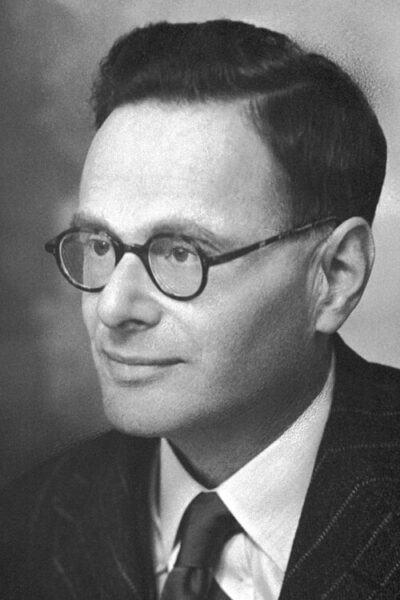
Hans Krebs
Hans Krebs was a German-British biochemist. Born August 25, 1900, in Hildesheim. Died November 22, 1981, in Oxford. Positions held include professor. Known for urea cycle, tricarboxylic acid cycle and glyoxylate cycle. Educated at University of Göttingen and University of Freiburg. Awards include Albert Lasker Award for Basic Medical Research, Nobel Prize in Physiology or Medicine and Royal Medal.
Facts
56 facts · 2 confirmed by two sources · 26 cited · 28 from one source
Where this comes from
Papalocal keeps its own record. It started from these sources; what each one said is kept here as it was copied, so a change on their side never changes this page by itself. Tap one to read its version.
What Wikidata says · copied November 16, 2026 · revision 2569004132
- Described as
- German-British biochemist (1900-1981)
- Other names
- Hans Adolf Krebs, H. A. Krebs, Sir Hans Adolf Krebs, H A Krebs, H. Krebs, H Krebs, Hans A. Krebs
- Born
- August 25, 1900 · 10 references
- Died
- November 22, 1981 · 9 references
- Born in
- Hildesheim · 1 reference
- Died in
- Oxford · 1 reference
- Citizen of
- Germany; United Kingdom (1939–) · 1 reference
- Occupation
- biochemist · 1 reference; physician · 1 reference; university teacher; Whitley Professor of Biochemistry (1954–1967); physiologist · 1 reference; biologist · 1 reference; docent · 1 reference
- Positions held
- professor
- Worked for
- University of Sheffield (1935–1954) · 1 reference; University of Oxford (1954–) · 1 reference; University of Freiburg (1931–1933) · 1 reference; Kaiser Wilhelm Society (1926–1930); University of Cambridge (1933–1935)
- Education
- University of Göttingen (1918–1919); University of Freiburg (1919–1923); University of Hamburg (1919–); LMU Munich; Humboldt-Universität zu Berlin (1923–1925); Gymnasium Andreanum
- Member of
- German Academy of Sciences Leopoldina (1956–) · 1 reference; American Academy of Arts and Sciences (1957–) · 1 reference; Bavarian Academy of Sciences and Humanities; Royal Society of London (1947–); National Academy of Sciences (1964–); Sociedad Española de Bioquímica y Biologia Molecular (1969–); Göttingen Academy of Sciences and Humanities in Lower Saxony; American Philosophical Society (1960–); Accademia Nazionale dei Lincei (1951–) · 1 reference
- Known for
- urea cycle · 1 reference; tricarboxylic acid cycle · 1 reference; glyoxylate cycle
- Awards
- Albert Lasker Award for Basic Medical Research (1953) · 1 reference; Nobel Prize in Physiology or Medicine (1953) · 2 references; Royal Medal (1954) · 1 reference; doctor honoris causa from the University of Paris (1956) · 1 reference; honorary doctor of the Hebrew University of Jerusalem (1960) · 1 reference; Copley Medal (1961) · 2 references; Croonian Medal and Lecture (1963); honorary citizen of Hildesheim (1966) · 1 reference; honorary doctor of the University of Bordeaux (1966) · 1 reference; Otto Warburg Medal (1969) · 1 reference; Pour le Mérite for Sciences and Arts order (1972) · 1 reference; honorary doctor of the University of Valencia (1975) · 1 reference; honorary doctorate of the University of Granada · 1 reference; Fellow of the Royal Society; Knight Bachelor
- Field
- biochemistry
- Children
- John Krebs, Baron Krebs
- Religion
- Judaism
- Lived in
- Germany · 1 reference
- Wikipedias with a page
- 67
Wikidata item Q57191 (wikidata.org/wiki/Q57191), public domain (CC0). Copied November 16, 2026.
What Wikipedia says · copied November 16, 2026 · revision 1372003043
Sir Hans Adolf Krebs, FRS (, German: [hans ˈʔaːdɔlf ˈkʁeːps] ; 25 August 1900 – 22 November 1981) was a German-British biologist, physician and biochemist. He was a pioneer scientist in the study of cellular respiration, a biochemical process in living cells that extracts energy from food and oxygen and makes it available to drive the processes of life. He is best known for his discoveries of two important sequences of chemical reactions that take place in the cells of nearly all organisms, including humans, other than anaerobic microorganisms, namely the citric acid cycle and the urea cycle. The former, often eponymously known as the "Krebs cycle", is the sequence of metabolic reactions that allows cells of oxygen-respiring organisms to obtain far more ATP from the food they consume than anaerobic processes such as glycolysis can supply; and its discovery earned Krebs a Nobel Prize in Physiology or Medicine in 1953. With Hans Kornberg, he also discovered the glyoxylate cycle, a slight variation of the citric acid cycle found in plants, bacteria, protists, and fungi.
Krebs died in 1981 in Oxford, where he had spent 13 years of his career from 1954 until his retirement in 1967 at the University of Oxford.
- Born, in its opening lines
- August 25, 1900
- Died, in its opening lines
- November 22, 1981
From the Wikipedia article “Hans Krebs (biochemist)” (en.wikipedia.org/wiki/Hans_Krebs_(biochemist)), by its contributors, under CC BY-SA 4.0 (creativecommons.org/licenses/by-sa/4.0/). Copied November 16, 2026; not changed.
Confirmed Two sources agree. Cited One source, and it names where it got it. One source One source, without a reference of its own. Sources disagree The sources disagree. We show the best-supported value and keep theirs below.
