
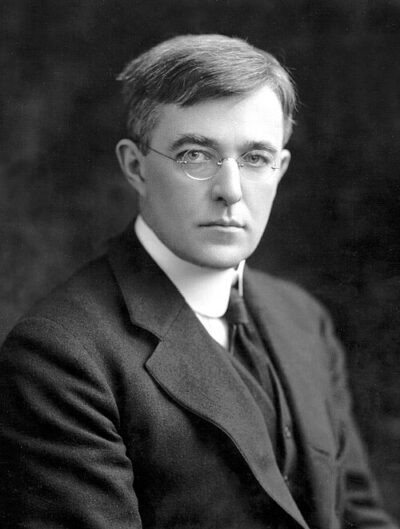
Irving Langmuir
Irving Langmuir was an American chemist and physicist. Born January 31, 1881, in Brooklyn. Died August 16, 1957, in Woods Hole. Known for Langmuir probe. Educated at University of Göttingen and Fu Foundation School of Engineering and Applied Science. Awards include William H. Nichols Medal (2 times), Hughes Medal and Rumford Prize.
Facts
39 facts · 2 confirmed by two sources · 26 cited · 11 from one source
Where this comes from
Papalocal keeps its own record. It started from these sources; what each one said is kept here as it was copied, so a change on their side never changes this page by itself. Tap one to read its version.
What Wikidata says · copied November 13, 2026 · revision 2568762299
- Described as
- American chemist and physicist (1881–1957)
- Born
- January 31, 1881 · 8 references
- Died
- August 16, 1957 · 10 references
- Born in
- Brooklyn · 2 references
- Died in
- Woods Hole · 1 reference
- Cause of death
- cardiovascular disease
- Citizen of
- United States
- Occupation
- physicist; chemist · 1 reference; academic; meteorologist
- Worked for
- General Electric · 1 reference
- Education
- University of Göttingen · 1 reference; Fu Foundation School of Engineering and Applied Science; Chestnut Hill Academy · 1 reference
- Member of
- National Academy of Sciences (1918–) · 2 references; German Academy of Sciences Leopoldina (1932–) · 1 reference; Royal Society of London (1935–) · 1 reference; Royal Swedish Academy of Sciences; American Academy of Arts and Sciences · 1 reference; American Association for the Advancement of Science · 1 reference; American Physical Society · 2 references; American Philosophical Society (1922–)
- Known for
- Langmuir probe · 1 reference
- Awards
- William H. Nichols Medal (2 times) (1915, 1920) · 1 reference; Hughes Medal (1918) · 1 reference; Rumford Prize (1920) · 1 reference; Perkin Medal (1928) · 1 reference; Willard Gibbs Award (1930) · 1 reference; Nobel Prize in Chemistry (1932) · 2 references; Holley Medal (1934) · 1 reference; Franklin Medal (1934) · 1 reference; Foreign Member of the Royal Society (1935) · 1 reference; John Scott Award (1937) · 2 references; Faraday Lectureship Prize (1939); Faraday Medal (1944) · 1 reference; John J. Carty Award for the Advancement of Science (1950) · 1 reference; National Inventors Hall of Fame (1989) · 1 reference; Fellow of the American Academy of Arts and Sciences · 1 reference
- Field
- chemistry · 1 reference
- Wikipedias with a page
- 75
Wikidata item Q184286 (wikidata.org/wiki/Q184286), public domain (CC0). Copied November 13, 2026.
What Wikipedia says · copied November 13, 2026 · revision 1384055221
Irving Langmuir (; January 31, 1881 – August 16, 1957) was an American chemist, physicist, and metallurgical engineer. He was awarded the Nobel Prize in Chemistry in 1932 for his work in surface chemistry.
Langmuir's most famous publication is the 1919 article "The Arrangement of Electrons in Atoms and Molecules" in which, building on Gilbert N. Lewis's cubical atom theory and Walther Kossel's chemical bonding theory, he outlined his "concentric theory of atomic structure". Langmuir became embroiled in a priority dispute with Lewis over this work; Langmuir's presentation skills were largely responsible for the popularization of the theory, although the credit for the theory itself belongs mostly to Lewis. While at General Electric from 1909 to 1950, Langmuir advanced several fields of physics and chemistry, inventing the gas-filled incandescent lamp and the hydrogen welding technique. The Langmuir Laboratory for Atmospheric Research near Socorro, New Mexico, was named in his honor, as was the American Chemical Society journal for surface science called Langmuir.
- Born, in its opening lines
- January 31, 1881
- Died, in its opening lines
- August 16, 1957
From the Wikipedia article “Irving Langmuir” (en.wikipedia.org/wiki/Irving_Langmuir), by its contributors, under CC BY-SA 4.0 (creativecommons.org/licenses/by-sa/4.0/). Copied November 13, 2026; not changed.
Confirmed Two sources agree. Cited One source, and it names where it got it. One source One source, without a reference of its own. Sources disagree The sources disagree. We show the best-supported value and keep theirs below.
