
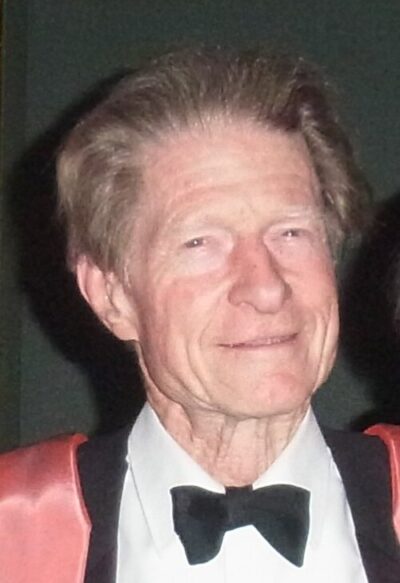
John Gurdon
John Gurdon was a British developmental biologist. Born October 2, 1933, in Dippenhall. Died October 7, 2025. Educated at Christ Church (2 times) and Eton College. Awards include Fellow of the Royal Society, Feldberg Foundation Prize and Croonian Medal and Lecture.
Facts
39 facts · 2 confirmed by two sources · 14 cited · 23 from one source
Where this comes from
Papalocal keeps its own record. It started from these sources; what each one said is kept here as it was copied, so a change on their side never changes this page by itself. Tap one to read its version.
What Wikidata says · copied November 16, 2026 · revision 2569175421
- Described as
- British developmental biologist (1933–2025)
- Other names
- Sir John Bertrand Gurdon, John B Gurdon, J B Gurdon, J Gurdon, John Bertrand Gurdon, John B. Gurdon
- Born
- October 2, 1933 · 5 references
- Died
- October 7, 2025 · 2 references
- Born in
- Dippenhall
- Citizen of
- United Kingdom
- Occupation
- biologist · 1 reference; physician; university teacher; research scientist · 1 reference; Nobel Prize winner · 1 reference
- Worked for
- University of Oxford; University of Cambridge (2001–) · 1 reference; California Institute of Technology · 1 reference
- Education
- Christ Church (2 times) (1956–1960) · 1 reference; Eton College · 1 reference; Edgeborough School · 1 reference
- Member of
- Royal Society of London; French Academy of Sciences; National Academy of Sciences (1980–); American Academy of Arts and Sciences; Royal Academy of Science, Letters and Fine Arts of Belgium; Academia Europaea (1991–) · 1 reference; American Philosophical Society (1983–)
- Awards
- Fellow of the Royal Society (1971) · 1 reference; Feldberg Foundation Prize (1975); Croonian Medal and Lecture (1976); Paul Ehrlich and Ludwig Darmstaedter Prize (1977); Portland Press Excellence in Science Award (1979); William Bate Hardy Prize (1984); Grand Prix Charles-Leopold Mayer (1984); Royal Medal (1985); Ross G. Harrison Award (1985); International Prize for Biology (1987) · 1 reference; Wolf Prize in Medicine (1989); Knight Bachelor (1995) · 1 reference; Edwin Grant Conklin Medal (2001); Copley Medal (2003) · 1 reference; Rosenstiel Award (2008) · 1 reference
- Field
- developmental biology
- Father
- William Nathaniel Gurdon · 2 references
- Wikipedias with a page
- 60
Wikidata item Q81218 (wikidata.org/wiki/Q81218), public domain (CC0). Copied November 16, 2026.
What Wikipedia says · copied November 16, 2026 · revision 1380372788
Sir John Bertrand Gurdon (2 October 1933 – 7 October 2025) was a British developmental biologist, best known for his pioneering research in Cellular differentiation and nuclear transplantation and cloning.
Awarded the Lasker Award in 2009, in 2012, he and Shinya Yamanaka were jointly awarded the Nobel Prize in Physiology or Medicine for the discovery that mature cells can be converted to stem cells.
- Born, in its opening lines
- October 2, 1933
- Died, in its opening lines
- October 7, 2025
From the Wikipedia article “John Gurdon” (en.wikipedia.org/wiki/John_Gurdon), by its contributors, under CC BY-SA 4.0 (creativecommons.org/licenses/by-sa/4.0/). Copied November 16, 2026; not changed.
Confirmed Two sources agree. Cited One source, and it names where it got it. One source One source, without a reference of its own. Sources disagree The sources disagree. We show the best-supported value and keep theirs below.
