
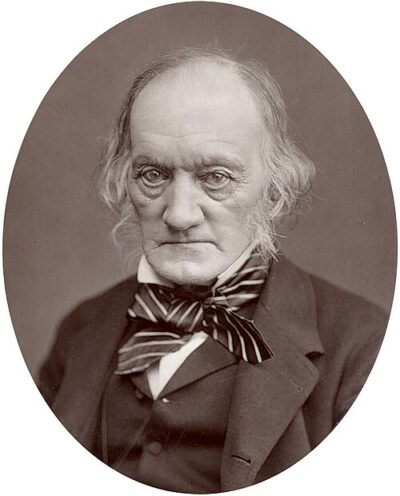
Richard Owen
Richard Owen was an English biologist and paleontologist. Born July 20, 1804, in Lancaster. Died December 18, 1892, in London. Positions held include museum director. Known for Natural History Museum. Educated at University of Edinburgh and Lancaster Royal Grammar School. Awards include Pour le Mérite for Sciences and Arts order, Fellow of the Royal Society and Knight Commander of the Order of the Bath.
Facts
49 facts · 2 confirmed by two sources · 12 cited · 35 from one source
Where this comes from
Papalocal keeps its own record. It started from these sources; what each one said is kept here as it was copied, so a change on their side never changes this page by itself. Tap one to read its version.
What Wikidata says · copied November 16, 2026 · revision 2559044136
- Described as
- English biologist and paleontologist (1804–1892)
- Other names
- Owen, R., Sir Richard Owen, Sir R. Owen, Owen, OWEN F.R.S., Owen, Richard, Owen R, R. Owen, Prof OWEN F.R.S.
- Born
- July 20, 1804 · 12 references
- Died
- December 18, 1892 · 10 references
- Born in
- Lancaster · 3 references
- Died in
- London · 2 references
- Buried in
- St Andrew's Church, Ham, London
- Citizen of
- United Kingdom of Great Britain and Ireland
- Occupation
- curator; biologist · 1 reference; paleontologist · 1 reference; zoologist · 1 reference; university teacher; anatomist · 1 reference; paleoanthropologist · 1 reference; writer · 1 reference
- Positions held
- museum director
- Worked for
- Hunterian Museum (1849–1856); Royal College of Surgeons of England (1836–); Natural History Museum (1856–1883)
- Education
- University of Edinburgh; Lancaster Royal Grammar School; Barts and The London School of Medicine and Dentistry
- Member of
- Royal Society of London (1834–); German Academy of Sciences Leopoldina; Royal Swedish Academy of Sciences (1843–); Saint Petersburg Academy of Sciences (1839–); Hungarian Academy of Sciences; French Academy of Sciences; American Academy of Arts and Sciences; Royal Prussian Academy of Sciences; Royal Microscopical Society; Accademia Nazionale delle Scienze detta dei XL
- Known for
- Natural History Museum · 1 reference
- Awards
- Pour le Mérite for Sciences and Arts order; Fellow of the Royal Society; Knight Commander of the Order of the Bath; Royal Medal (1846); Copley Medal (1851) · 1 reference; Clarke Medal (1878); Linnean Medal (1888); Royal Society Bakerian Medal (1844) · 1 reference; Croonian Medal and Lecture (1851); Wollaston Medal (1838) · 1 reference; Pour le Mérite · 1 reference; Honorary Fellow of the Royal Society Te Apārangi (1870–) · 1 reference
- Field
- zoology; paleontology
- Spouse
- Caroline Amelia Clift (1835–) · 1 reference
- Children
- William Owen · 1 reference
- Lived in
- England · 1 reference
- Wikipedias with a page
- 65
Wikidata item Q151556 (wikidata.org/wiki/Q151556), public domain (CC0). Copied November 16, 2026.
What Wikipedia says · copied November 16, 2026 · revision 1381462066
Sir Richard Owen (20 July 1804 – 18 December 1892) was an English biologist, comparative anatomist and palaeontologist. Owen is generally considered to have been an outstanding naturalist with a remarkable gift for interpreting fossils.
Owen produced a vast array of scientific work, but is probably best remembered today for coining the word Dinosauria (meaning "Terrible Reptile" or "Fearfully Great Reptile"). An outspoken critic of Charles Darwin's theory of evolution by natural selection, Owen agreed with Darwin that evolution occurred but thought it was more complex than outlined in Darwin's On the Origin of Species. Owen's approach to evolution can be considered to have anticipated the issues that have gained greater attention with the recent emergence of evolutionary developmental biology.
Owen was the first president of the Microscopical Society of London in 1839 and edited many issues of its journal – then known as The Microscopic Journal. Owen also campaigned for the natural specimens in the British Museum to be given a new home. This resulted in the establishment, in 1881, of the now world-famous Natural History Museum in South Kensington, London. Bill Bryson argues that, "by making the Natural History Museum an institution for everyone, Owen transformed our expectations of what museums are for."
While he made several contributions to science and public learning, Owen was a controversial figure among his contemporaries, both for his disagreements on matters of common descent and for accusations that he took credit for other people's work.
- Born, in its opening lines
- July 20, 1804
- Died, in its opening lines
- December 18, 1892
From the Wikipedia article “Richard Owen” (en.wikipedia.org/wiki/Richard_Owen), by its contributors, under CC BY-SA 4.0 (creativecommons.org/licenses/by-sa/4.0/). Copied November 16, 2026; not changed.
Confirmed Two sources agree. Cited One source, and it names where it got it. One source One source, without a reference of its own. Sources disagree The sources disagree. We show the best-supported value and keep theirs below.
