
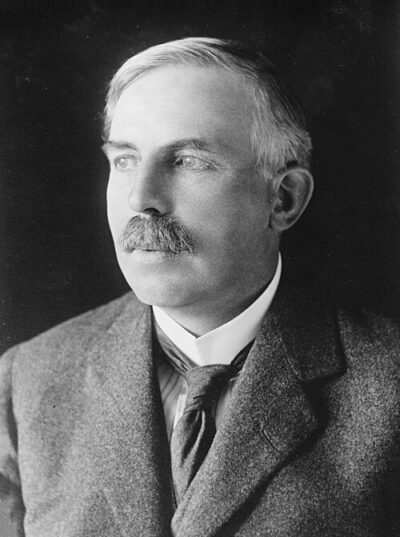
Ernest Rutherford
Ernest Rutherford was a New Zealand physicist. Born August 30, 1871, in Spring Grove. Died October 19, 1937, in Cambridge. Positions held include President of the Royal Society (1925–1930), member of the House of Lords (1931–1937) and Langworthy Professor (1907–1919). Educated at University of Canterbury and University of Cambridge. Awards include Hector Medal, Nobel Prize in Chemistry and Matteucci Medal.
Facts
58 facts · 2 confirmed by two sources · 50 cited · 6 from one source
Where this comes from
Papalocal keeps its own record. It started from these sources; what each one said is kept here as it was copied, so a change on their side never changes this page by itself. Tap one to read its version.
What Wikidata says · copied November 16, 2026 · revision 2568758211
- Described as
- New Zealand physicist (1871–1937)
- Other names
- Ernest Lord Rutherford, Ernest Rutherford, primer barón Rutherford. de Nelson, Ernest, Lord Rutherford, E. Rutherford
- Born
- August 30, 1871 · 10 references
- Died
- October 19, 1937 · 12 references
- Born in
- Spring Grove · 1 reference
- Died in
- Cambridge · 3 references
- Buried in
- Westminster Abbey · 2 references
- Citizen of
- New Zealand · 1 reference
- Occupation
- nuclear physicist · 1 reference; chemist · 1 reference; physicist · 1 reference; professor · 1 reference; politician · 1 reference; university teacher · 1 reference
- Positions held
- President of the Royal Society (1925–1930) · 1 reference; member of the House of Lords (1931–1937) · 1 reference; Langworthy Professor (1907–1919)
- Worked for
- Victoria University of Manchester (1907–1919) · 1 reference; McGill University (1898–1907) · 1 reference; Cavendish Laboratory (1919–1937); University of Manchester · 1 reference
- Education
- University of Canterbury · 1 reference; University of Cambridge · 1 reference; Trinity College · 1 reference; Nelson College · 1 reference
- Member of
- Order of Merit · 1 reference; Royal Society of London (1903–) · 1 reference; German Academy of Sciences Leopoldina · 1 reference; Pontifical Academy of Sciences · 2 references; Bavarian Academy of Sciences and Humanities · 1 reference; Academy of Sciences of the USSR · 1 reference; Royal Swedish Academy of Sciences · 1 reference; French Academy of Sciences · 1 reference; American Academy of Arts and Sciences · 1 reference; Russian Academy of Sciences · 1 reference
- Awards
- Hector Medal (1916) · 1 reference; Nobel Prize in Chemistry (1908) · 3 references; Matteucci Medal (1913) · 1 reference; Copley Medal (1922) · 2 references; Franklin Medal (1924) · 1 reference; Elliott Cresson Medal (1910) · 1 reference; Fellow of the Royal Society · 1 reference; Faraday Lectureship Prize (1936) · 1 reference; Wilhelm Exner Medal (1936) · 1 reference; Faraday Medal (1930) · 1 reference; Rumford Medal (1904) · 1 reference; Albert Medal (1928) · 2 references; Royal Society Bakerian Medal (1920) · 2 references; Honorary Fellow of the Royal Society Te Apārangi (1919–) · 1 reference; Honorary Fellow of the Royal Society of Edinburgh
- Field
- physics · 2 references; nuclear physics · 2 references; chemistry · 1 reference; radioactivity · 1 reference
- Spouse
- Mary Georgina Rutherford (1900–) · 2 references; Mary Rutherford · 1 reference
- Children
- Eileen Mary Rutherford · 1 reference
- Father
- James Rutherford · 1 reference
- Mother
- Martha Thompson · 1 reference
- Lived in
- New Zealand · 1 reference
- Wikipedias with a page
- 174
Wikidata item Q9123 (wikidata.org/wiki/Q9123), public domain (CC0). Copied November 16, 2026.
What Wikipedia says · copied November 16, 2026 · revision 1381202354
Ernest Rutherford, 1st Baron Rutherford of Nelson (30 August 1871 – 19 October 1937) was a New Zealand physicist and chemist who was a pioneering researcher in both atomic and nuclear physics. He has been described as "the father of nuclear physics" and "the greatest experimentalist since Michael Faraday". In 1908, he was awarded the Nobel Prize in Chemistry "for his investigations into the disintegration of the elements, and the chemistry of radioactive substances."
Rutherford's discoveries include the concept of radioactive half-life, the radioactive element radon, and the differentiation and naming of alpha and beta radiation. Together with Thomas Royds, Rutherford is credited with proving that alpha radiation is composed of helium nuclei. In 1911, he theorised that atoms have their charge concentrated in a very small nucleus. He arrived at this theory through his discovery and interpretation of Rutherford scattering during the gold foil experiment performed by Hans Geiger and Ernest Marsden. In 1912, he invited Niels Bohr to join his lab, leading to the Bohr model of the atom. In 1917, he performed the first artificially induced nuclear reaction by conducting experiments in which nitrogen nuclei were bombarded with alpha particles. These experiments led him to discover the emission of a subatomic particle that he initially called the "hydrogen atom", but later (more precisely) renamed the proton. He is also credited with developing the atomic numbering system alongside Henry Moseley. His other achievements include advancing the fields of radio communications and ultrasound technology.
Rutherford became Director of the Cavendish Laboratory at the University of Cambridge in 1919. Under his leadership, the neutron was discovered by James Chadwick in 1932. In the same year, the first controlled experiment to split the nucleus was performed by John Cockcroft and Ernest Walton, working under his direction. In honour of his scientific advancements, Rutherford was recognised as a baron of the United Kingdom. After his death in 1937, he was buried in Westminster Abbey near Charles Darwin and Isaac Newton. The chemical element rutherfordium (104Rf) was named after him in 1997. In 1999, he was named the tenth greatest physicist of all time. His portrait has been on the New Zealand one hundred-dollar note since 1999.
- Born, in its opening lines
- August 30, 1871
- Died, in its opening lines
- October 19, 1937
From the Wikipedia article “Ernest Rutherford” (en.wikipedia.org/wiki/Ernest_Rutherford), by its contributors, under CC BY-SA 4.0 (creativecommons.org/licenses/by-sa/4.0/). Copied November 16, 2026; not changed.
Confirmed Two sources agree. Cited One source, and it names where it got it. One source One source, without a reference of its own. Sources disagree The sources disagree. We show the best-supported value and keep theirs below.
