
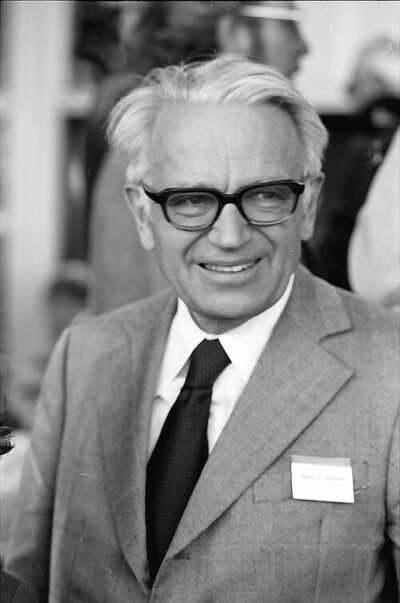
Gerhard Herzberg
Gerhard Herzberg was a German-Canadian physicist and physical chemist. Born December 25, 1904, in Hamburg. Died March 3, 1999, in Ottawa. Positions held include Chancellor of Carleton University (1973–1980). Educated at University of Göttingen and Technical University of Darmstadt. Awards include Fellow of the Royal Society, Faraday Lectureship Prize and Royal Medal.
Facts
57 facts · 2 confirmed by two sources · 19 cited · 36 from one source
Where this comes from
Papalocal keeps its own record. It started from these sources; what each one said is kept here as it was copied, so a change on their side never changes this page by itself. Tap one to read its version.
What Wikipedia says · copied November 13, 2026 · revision 1379515237
Gerhard Heinrich Friedrich Otto Julius Herzberg, (German: [ˈɡeːɐ̯.haʁt ˈhɛʁt͡sˌbɛʁk] ; December 25, 1904 – March 3, 1999) was a German-Canadian pioneering physicist and physical chemist, who won the Nobel Prize for Chemistry in 1971, "for his contributions to the knowledge of electronic structure and geometry of molecules, particularly free radicals". Herzberg's main work concerned atomic and molecular spectroscopy. He is well known for using these techniques that determine the structures of diatomic and polyatomic molecules, including free radicals which are difficult to investigate in any other way, and for the chemical analysis of astronomical objects. Herzberg served as Chancellor of Carleton University in Ottawa, Canada from 1973 to 1980.
- Born, in its opening lines
- December 25, 1904
- Died, in its opening lines
- March 3, 1999
From the Wikipedia article “Gerhard Herzberg” (en.wikipedia.org/wiki/Gerhard_Herzberg), by its contributors, under CC BY-SA 4.0 (creativecommons.org/licenses/by-sa/4.0/). Copied November 13, 2026; not changed.
What Wikidata says · copied November 14, 2026 · revision 2569007627
- Described as
- German-Canadian physicist and physical chemist (1904-1999)
- Other names
- Gerhard Heinrich Friedrich Otto Julius Herzberg
- Born
- December 25, 1904 · 9 references
- Died
- March 3, 1999 · 8 references
- Born in
- Hamburg · 2 references
- Died in
- Ottawa · 1 reference
- Citizen of
- Canada; Germany; Nazi Germany
- Occupation
- astronomer; physicist · 1 reference; chemist; university teacher; physical chemist
- Positions held
- Chancellor of Carleton University (1973–1980) · 1 reference
- Worked for
- Technical University of Darmstadt; Cornell University; University of Chicago; University of Bristol; University of Göttingen · 1 reference; National Research Council Canada; University of Saskatchewan; Yerkes Observatory
- Education
- University of Göttingen; Technical University of Darmstadt · 1 reference; Gelehrtenschule des Johanneums
- Member of
- Royal Society of London (1951–); Royal Swedish Academy of Sciences; Royal Society of Canada; International Academy of Quantum Molecular Science; Pontifical Academy of Sciences · 1 reference; American Academy of Arts and Sciences; Hungarian Academy of Sciences; National Academy of Sciences (1968–); Board of Governors of Carleton University (1973–1980); Japan Academy (1976–) · 1 reference
- Awards
- Fellow of the Royal Society (1951); Faraday Lectureship Prize (1970); Royal Medal (1971); Nobel Prize in Chemistry (1971) · 2 references; Frederic Ives Medal (1964) · 1 reference; Companion of the Order of Canada; Willard Gibbs Award (1969) · 1 reference; Henry Marshall Tory Medal (1953) · 1 reference; Centenary Prize (1958); Fellow of the American Physical Society; honorary doctorate at the Laval University (1979) · 1 reference; Royal Society Bakerian Medal (1960) · 1 reference; Chemical Institute of Canada Medal (1972); Earle K. Plyler Prize (1985) · 1 reference; Fellow of the Royal Society of Canada
- Field
- physical chemistry · 1 reference; physics · 1 reference; chemistry · 1 reference; atomic spectroscopy · 1 reference; molecular spectroscopy · 1 reference
- Spouse
- Luise Hedwig Herzberg
- Religion
- agnosticism · 1 reference
- Lived in
- Darmstadt · 1 reference
- Wikipedias with a page
- 55
Wikidata item Q76602 (wikidata.org/wiki/Q76602), public domain (CC0). Copied November 14, 2026.
Confirmed Two sources agree. Cited One source, and it names where it got it. One source One source, without a reference of its own. Sources disagree The sources disagree. We show the best-supported value and keep theirs below.
