
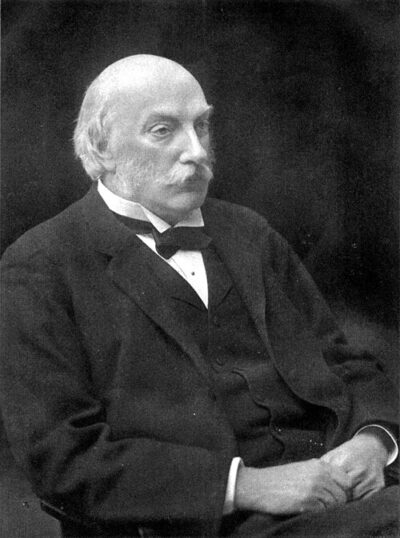
John William Strutt
John William Strutt was an English physicist. Born November 12, 1842, in Langford Grove. Died June 30, 1919, in Terling Place. Positions held include Member of the Privy Council of the United Kingdom (1905–), President of the Royal Society (1905–1908) and member of the House of Lords (1873–1919). Known for argon, Rayleigh scattering and Rayleigh–Bénard convection. Educated at Harrow School and Trinity College. Awards include Nobel Prize in Physics, Fellow of the Royal Society and Copley Medal.
Facts
71 facts · 2 confirmed by two sources · 34 cited · 35 from one source
Where this comes from
Papalocal keeps its own record. It started from these sources; what each one said is kept here as it was copied, so a change on their side never changes this page by itself. Tap one to read its version.
What Wikidata says · copied November 16, 2026 · revision 2563195825
- Described as
- English physicist (1842–1919)
- Other names
- Lord Rayleigh, John Strutt, Lord Rayleigh, John William Strutt, 3rd Baron Rayleigh of Terling Place, 3rd Baron Rayleigh
- Born
- November 12, 1842 · 11 references
- Died
- June 30, 1919 · 11 references
- Born in
- Langford Grove · 3 references
- Died in
- Terling Place · 1 reference
- Buried in
- Terling (All Saints) Churchyard · 1 reference
- Name at birth
- John William Strutt · 1 reference
- Citizen of
- United Kingdom of Great Britain and Ireland
- Occupation
- physicist · 1 reference; politician; university teacher; mathematician · 1 reference; chemist · 1 reference
- Positions held
- Member of the Privy Council of the United Kingdom (1905–) · 1 reference; President of the Royal Society (1905–1908) · 1 reference; member of the House of Lords (1873–1919); Lord Lieutenant of Essex (1892–1901) · 1 reference; Chancellor of the University of Cambridge (1908–1919); president (1876) · 1 reference; chairperson (1919) · 1 reference; director (1879–1884) · 1 reference
- Worked for
- University of Cambridge (1879–1884) · 1 reference; Royal Institution (1887–1905) · 1 reference
- Education
- Harrow School (1856–) · 2 references; Trinity College (1861–1865) · 4 references; Eton College · 3 references; University of Cambridge (–1868) · 2 references
- Member of
- Royal Society of London; Royal Swedish Academy of Sciences; Bavarian Academy of Sciences and Humanities; Saint Petersburg Academy of Sciences; Hungarian Academy of Sciences; French Academy of Sciences; American Academy of Arts and Sciences; Russian Academy of Sciences; Royal Prussian Academy of Sciences; Royal Netherlands Academy of Arts and Sciences
- Known for
- argon; Rayleigh scattering; Rayleigh–Bénard convection; Rayleigh wave; The theory of sound; Rayleigh number; Rayleigh–Jeans law; Rayleigh quotient; Rayleigh–Taylor instability; Plateau–Rayleigh instability
- Awards
- Nobel Prize in Physics (1904) · 2 references; Fellow of the Royal Society (1873) · 1 reference; Copley Medal (1899) · 2 references; Faraday Lectureship Prize (1895) · 1 reference; Leconte Prize (1895) · 1 reference; Royal Medal (1882) · 1 reference; Elliott Cresson Medal (1913) · 1 reference; De Morgan Medal (1890) · 1 reference; Rumford Medal (2 times) (1914, 1920) · 1 reference; Matteucci Medal (1894) · 1 reference; Albert Medal (1905) · 1 reference; Royal Society Bakerian Medal (1902) · 2 references; Bressa Prize (1891) · 1 reference; Order of Merit (1902) · 1 reference; Smith's Prize (1865) · 1 reference
- Field
- physics
- Spouse
- Evelyn Strutt, Baroness Rayleigh of Terling Place (1871–) · 3 references
- Children
- Robert Strutt, 4th Baron Rayleigh · 1 reference; Arthur Strutt · 1 reference; Julian Balfour Strutt · 1 reference; William Maitland Strutt · 1 reference
- Father
- John Strutt, 2nd Baron Rayleigh of Terling Place · 2 references
- Mother
- Clara Vicars · 2 references
- Religion
- Anglicanism
- Lived in
- Terling Place · 1 reference
- Wikipedias with a page
- 95
Wikidata item Q83297 (wikidata.org/wiki/Q83297), public domain (CC0). Copied November 16, 2026.
What Wikipedia says · copied November 16, 2026 · revision 1381609136
John William Strutt, 3rd Baron Rayleigh ( RAY-lee; 12 November 1842 – 30 June 1919), was a British physicist and hereditary peer who received the Nobel Prize in Physics in 1904 for his discovery of argon.
In 1871, Rayleigh published the first theoretical treatment of the elastic scattering of light by particles much smaller than the light's wavelength, a phenomenon now known as Rayleigh scattering, which notably explains why the sky is blue. He studied and described transverse surface waves in solids, now known as Rayleigh waves. He contributed extensively to fluid dynamics, with concepts such as the Rayleigh number (a dimensionless number associated with natural convection), Rayleigh flow, the Rayleigh–Taylor instability, and Rayleigh's criterion for the stability of Taylor–Couette flow.
Rayleigh also formulated the circulation theory of aerodynamic lift. In optics, he proposed a well-known criterion for angular resolution. His derivation of the Rayleigh–Jeans law for classical black-body radiation later played an important role in the birth of quantum mechanics (see ultraviolet catastrophe). His textbook, The Theory of Sound (1877), is still used today by acousticians and engineers. He introduced the Rayleigh test for circular non-uniformity, which the Rayleigh plot visualises.
Rayleigh served as President of the Royal Society from 1905 to 1908, and as Chancellor of the University of Cambridge from 1908 until his death in 1919.
- Born, in its opening lines
- November 12, 1842
- Died, in its opening lines
- June 30, 1919
From the Wikipedia article “John William Strutt, 3rd Baron Rayleigh” (en.wikipedia.org/wiki/John_William_Strutt,_3rd_Baron_Rayleigh), by its contributors, under CC BY-SA 4.0 (creativecommons.org/licenses/by-sa/4.0/). Copied November 16, 2026; not changed.
Confirmed Two sources agree. Cited One source, and it names where it got it. One source One source, without a reference of its own. Sources disagree The sources disagree. We show the best-supported value and keep theirs below.
