
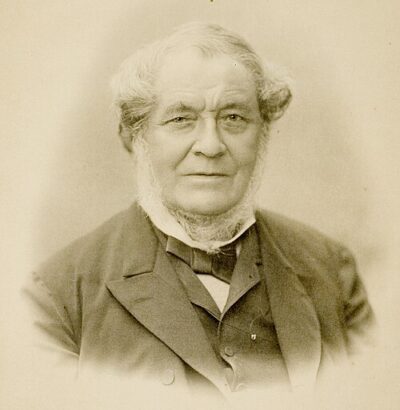
Robert Bunsen
Robert Bunsen was a German chemist. Born March 30, 1811, in Göttingen. Died August 16, 1899, in Heidelberg. Positions held include Privatdozent (1834–1836), chemistry teacher (1836–1839) and extraordinary professor (1839–1841). Educated at University of Göttingen and Frederick William University Berlin. Awards include Davy Medal, Copley Medal and Albert Medal.
Facts
51 facts · 2 confirmed by two sources · 36 cited · 13 from one source
Where this comes from
Papalocal keeps its own record. It started from these sources; what each one said is kept here as it was copied, so a change on their side never changes this page by itself. Tap one to read its version.
What Wikidata says · copied November 16, 2026 · revision 2567935841
- Described as
- German chemist (1811-1899)
- Other names
- Robert Wilhelm Eberhard Bunsen, Robert William Bunsen, Robert Wilhelm Bunsen
- Born
- March 30, 1811 · 5 references
- Died
- August 16, 1899 · 15 references
- Born in
- Göttingen · 11 references
- Died in
- Heidelberg · 11 references
- Buried in
- Bergfriedhof · 1 reference
- Citizen of
- Kingdom of Prussia · 1 reference
- Occupation
- chemist · 5 references; physicist · 2 references; inventor · 1 reference; university teacher · 2 references; teacher · 1 reference; experimentalist · 2 references; naturalist · 1 reference; professor · 1 reference
- Positions held
- Privatdozent (1834–1836) · 1 reference; chemistry teacher (1836–1839) · 3 references; extraordinary professor (1839–1841) · 3 references; professor (1841–1889) · 2 references
- Worked for
- University of Wrocław (1851–1852) · 2 references; Heidelberg University (1852–) · 2 references; University of Marburg (1839–1851) · 2 references; University of Göttingen (1834–1836) · 2 references; Höhere Gewerbeschule Kassel (1836–1839) · 3 references
- Education
- University of Göttingen (1828–) · 2 references; Frederick William University Berlin · 1 reference; University of Vienna · 1 reference
- Member of
- Royal Society of London (1858–); German Academy of Sciences Leopoldina (1851–) · 2 references; Royal Swedish Academy of Sciences; French Academy of Sciences; Bavarian Academy of Sciences and Humanities; Saint Petersburg Academy of Sciences; Hungarian Academy of Sciences; American Academy of Arts and Sciences (1864–); Russian Academy of Sciences (1862–); Royal Prussian Academy of Sciences
- Awards
- Davy Medal (1877) · 1 reference; Copley Medal (1860) · 1 reference; Albert Medal (1898) · 1 reference; Pour le Mérite for Sciences and Arts order (1864); Helmholtz Medal (1892); Bavarian Maximilian Order for Science and Art (1865); Foreign Member of the Royal Society (1858) · 1 reference; honorary member of the Physics Association (Frankfurt am Main, Germany) (1839)
- Field
- spectrochemical analysis · 2 references; chemistry · 1 reference; spectral analysis · 1 reference
- Father
- Christian Bunsen · 6 references
- Mother
- Auguste Friederike Bunsen · 4 references
- Siblings
- Gustav Bunsen · 1 reference
- Religion
- Protestantism · 1 reference
- Wikipedias with a page
- 81
Wikidata item Q71031 (wikidata.org/wiki/Q71031), public domain (CC0). Copied November 16, 2026.
What Wikipedia says · copied November 16, 2026 · revision 1378886389
Robert Wilhelm Eberhard Bunsen (German: [ˈʁoːbɛʁt ˈbʊnzn̩];
30 March 1811
– 16 August 1899) was a German chemist. He investigated emission spectra of heated elements, and discovered caesium in 1860 and rubidium in 1861 with the physicist Gustav Kirchhoff. The Bunsen–Kirchhoff Award for spectroscopy is named after Bunsen and Kirchhoff.
Bunsen also developed several gas-analytical methods, was a pioneer in photochemistry, and did early work in the field of organic arsenic chemistry. With his laboratory assistant Peter Desaga, he developed the Bunsen burner, an improvement on the laboratory burners then in use.
- Born, in its opening lines
- March 30, 1811
- Died, in its opening lines
- August 16, 1899
From the Wikipedia article “Robert Bunsen” (en.wikipedia.org/wiki/Robert_Bunsen), by its contributors, under CC BY-SA 4.0 (creativecommons.org/licenses/by-sa/4.0/). Copied November 16, 2026; not changed.
Confirmed Two sources agree. Cited One source, and it names where it got it. One source One source, without a reference of its own. Sources disagree The sources disagree. We show the best-supported value and keep theirs below.
