
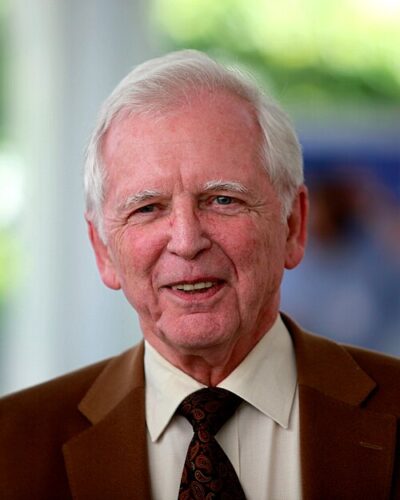
Harald zur Hausen
Harald zur Hausen was a German virologist and professor emeritus. Born March 11, 1936, in Gelsenkirchen. Died May 29, 2023, in Heidelberg. Educated at University of Bonn and University of Hamburg. Awards include Nobel Prize in Physiology or Medicine, Order of Merit of Baden-Württemberg and Knight Commander's Cross of the Order of Merit of the Federal Republic of Germany.
Facts
45 facts · 2 confirmed by two sources · 15 cited · 28 from one source
Where this comes from
Papalocal keeps its own record. It started from these sources; what each one said is kept here as it was copied, so a change on their side never changes this page by itself. Tap one to read its version.
What Wikidata says · copied November 16, 2026 · revision 2569097277
- Described as
- German virologist and professor emeritus (1936–2023)
- Other names
- Harald Zur Hausen
- Born
- March 11, 1936 · 5 references
- Died
- May 29, 2023 · 2 references
- Born in
- Gelsenkirchen · 1 reference
- Died in
- Heidelberg · 1 reference
- Citizen of
- Germany
- Occupation
- virologist · 1 reference; physician · 1 reference; university teacher · 1 reference; oncologist · 1 reference; Nobel Prize winner · 1 reference
- Worked for
- University of Erlangen–Nuremberg · 1 reference; University of Freiburg · 1 reference; Heidelberg University · 1 reference; University of Würzburg · 1 reference; University of Pennsylvania · 1 reference
- Education
- University of Bonn; University of Hamburg; University of Düsseldorf; Heidelberg University · 1 reference
- Member of
- German Academy of Sciences at Berlin; German Academy of Sciences Leopoldina · 1 reference; Heidelberg Academy of Sciences and Humanities (1986–) · 1 reference; Hungarian Academy of Sciences; National Academy of Sciences (2009–) · 1 reference; Polish Academy of Sciences; European Molecular Biology Organization; Academia Europaea (1990–) · 1 reference; Slovenian Academy of Sciences and Arts
- Awards
- Nobel Prize in Physiology or Medicine (2008) · 2 references; Order of Merit of Baden-Württemberg (2006); Knight Commander's Cross of the Order of Merit of the Federal Republic of Germany (2009) · 1 reference; M. W. Beijerinck Prize for Virology (1992); Canada Gairdner International Award (2008); William B. Coley Award (2006) · 1 reference; German Cancer Aid Award (2006); Paul Ehrlich and Ludwig Darmstaedter Prize (1994); Bavarian Maximilian Order for Science and Art (2010); Tsungming Tu Award (2011); Jacob-Henle-Medaille (1996); German Cancer Award (1986); Ernst Jung Prize for Medicine (1996); Johann Georg Zimmermann Medal (2006); Johann Gottlieb Fichte Prize (2006)
- Field
- virology · 1 reference
- Spouse
- Ethel-Michele de Villiers · 1 reference
- Wikipedias with a page
- 69
Wikidata item Q75847 (wikidata.org/wiki/Q75847), public domain (CC0). Copied November 16, 2026.
What Wikipedia says · copied November 16, 2026 · revision 1366940197
Harald zur Hausen NAS EASA APS (German pronunciation: [ˈhaʁalt tsuːɐ̯ ˈhaʊzn̩] ; 11 March 1936 – 29 May 2023) was a German virologist. He carried out research on cervical cancer and discovered the role of papilloma viruses in cervical cancer, for which he received the Nobel Prize in Physiology or Medicine in 2008. He was chairman of the German Cancer Research Center (Deutsches Krebsforschungszentrum, DKFZ) in Heidelberg.
- Born, in its opening lines
- March 11, 1936
- Died, in its opening lines
- May 29, 2023
From the Wikipedia article “Harald zur Hausen” (en.wikipedia.org/wiki/Harald_zur_Hausen), by its contributors, under CC BY-SA 4.0 (creativecommons.org/licenses/by-sa/4.0/). Copied November 16, 2026; not changed.
Confirmed Two sources agree. Cited One source, and it names where it got it. One source One source, without a reference of its own. Sources disagree The sources disagree. We show the best-supported value and keep theirs below.
