
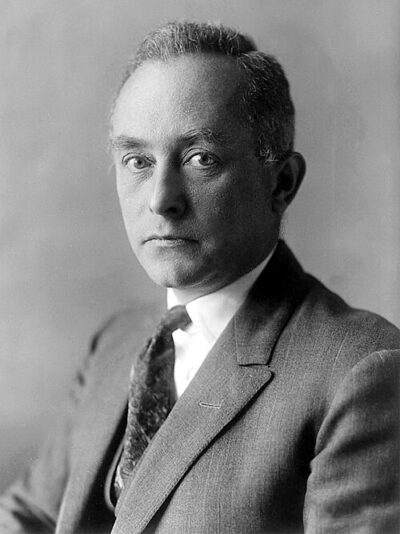
Max Born
Max Born was a German-Jewish physicist and mathematician. Born December 11, 1882, in Wrocław. Died January 5, 1970, in Göttingen. Positions held include professor. Known for probability amplitude and Born-Oppenheimer approximation. Educated at University of Göttingen and Heidelberg University. Awards include Fellow of the Royal Society, Great Cross with Star and Sash of the Order of Merit of the Federal Republic of Germany and Nobel Prize in Physics.
Facts
64 facts · 2 confirmed by two sources · 22 cited · 40 from one source
Where this comes from
Papalocal keeps its own record. It started from these sources; what each one said is kept here as it was copied, so a change on their side never changes this page by itself. Tap one to read its version.
What Wikidata says · copied November 16, 2026 · revision 2568731774
- Described as
- German-Jewish physicist and mathematician (1882–1970)
- Born
- December 11, 1882 · 11 references
- Died
- January 5, 1970 · 12 references
- Born in
- Wrocław · 7 references
- Died in
- Göttingen · 6 references
- Buried in
- Göttingen City Cemetery · 2 references
- Citizen of
- German Reich; United Kingdom (1939–) · 1 reference; United Kingdom of Great Britain and Ireland (–1927)
- Occupation
- physicist · 4 references; mathematician · 1 reference; university teacher · 1 reference; theoretical physicist; scientist · 1 reference
- Positions held
- professor
- Worked for
- Goethe University Frankfurt (1919–1921); University of Göttingen (2 times) (1908–1933); Humboldt-Universität zu Berlin (1914–1919); University of Edinburgh (1936–1952); Artillery Testing Commission (1915–1918)
- Education
- University of Göttingen (1904–1906); Heidelberg University (1902); University of Wrocław (1901–1904); University of Zurich (1903); Gonville and Caius College
- Member of
- Royal Society of London (1939–); Royal Prussian Academy of Sciences; German Academy of Sciences at Berlin; German Academy of Sciences Leopoldina · 1 reference; Göttingen Academy of Sciences and Humanities in Lower Saxony; Academy of Sciences of the USSR; Royal Swedish Academy of Sciences; Göttingen Eighteen; American Academy of Arts and Sciences; Russian Academy of Sciences
- Known for
- probability amplitude; Born-Oppenheimer approximation
- Awards
- Fellow of the Royal Society (1939) · 1 reference; Great Cross with Star and Sash of the Order of Merit of the Federal Republic of Germany (1959); Nobel Prize in Physics (1954) · 2 references; Max Planck Medal (1948); Hughes Medal (1950); Fellow of the Royal Society of Edinburgh (1937); Guthrie Lecture (1953) · 1 reference; Makdougall Brisbane Prize (1942); honorary doctor of the University of Bordeaux (1948) · 2 references; honorary member of the Physics Association (Frankfurt am Main, Germany) (1954); Gunning Victoria Jubilee Prize (1944)
- Field
- theoretical physics; physics · 1 reference; quantum mechanics · 1 reference
- Spouse
- Hedwig Born (1913–) · 2 references
- Children
- Gustav Victor Rudolf Born · 1 reference; Irene Helen Käthe Born · 2 references
- Father
- Gustav Born · 2 references
- Mother
- Margarethe Kauffmann · 2 references
- Siblings
- Wolfgang Born · 1 reference
- Religion
- Judaism; Lutheranism · 1 reference
- Military branch
- Imperial German Army (1906–1907)
- Lived in
- Göttingen; Edinburgh; Wrocław; Cambridge; Bad Pyrmont
- Wikipedias with a page
- 120
Wikidata item Q58978 (wikidata.org/wiki/Q58978), public domain (CC0). Copied November 16, 2026.
What Wikipedia says · copied November 16, 2026 · revision 1383133139
Max Born (German: [ˈmaks ˈbɔʁn] ; 11 December 1882 – 5 January 1970) was a German–British theoretical physicist who was instrumental in the development of quantum mechanics. He also made contributions to solid-state physics and optics, and supervised the work of a number of notable physicists in the 1920s and 1930s. He shared the 1954 Nobel Prize in Physics with Walther Bothe "for his fundamental research in quantum mechanics, especially for his statistical interpretation of the wavefunction."
Born entered the University of Göttingen in 1904, where he met the three renowned mathematicians Felix Klein, David Hilbert, and Hermann Minkowski. He wrote his Ph.D. thesis on the subject of the stability of elastic wires and tapes, winning the university's Philosophy Faculty Prize. In 1905, he began researching special relativity with Minkowski, and subsequently wrote his habilitation thesis on the Thomson model of the atom. A chance meeting with Fritz Haber in Berlin in 1918 led to discussion of how an ionic compound is formed when a metal reacts with a halogen, which is now known as the Born–Haber cycle.
During World War I, Born was originally placed as a radio operator, but his specialist knowledge led to his being moved to research duties on sound ranging. In 1921 Born returned to Göttingen, where he arranged another chair for his long-time friend and colleague James Franck. Under Born, Göttingen became one of the world's foremost centres for physics. In 1925, Born and Werner Heisenberg formulated the matrix mechanics representation of quantum mechanics. The following year, he formulated the now-standard interpretation of the probability density function for ψ*ψ in the Schrödinger equation, for which he was awarded the Nobel Prize in 1954.
His influence extended far beyond his own research: Max Delbrück, Siegfried Flügge, Friedrich Hund, Pascual Jordan, Maria Goeppert Mayer, Lothar Nordheim, Robert Oppenheimer, and Victor Weisskopf all received their Ph.D. degrees under Born at Göttingen, and his assistants included Enrico Fermi, Werner Heisenberg, Gerhard Herzberg, Friedrich Hund, Wolfgang Pauli, Léon Rosenfeld, Edward Teller, and Eugene Wigner.
In January 1933, when the Nazi Party came to power in Germany, Born, who was born into a Jewish family, was suspended from his professorship at the University of Göttingen. He emigrated to the United Kingdom, where he took a job at St John's College, Cambridge, and wrote a popular science book, The Restless Universe, as well as Atomic Physics, which soon became a standard textbook. In October 1936, he was appointed Tait Professor of Natural Philosophy at the University of Edinburgh, where, working with German-born assistants Ernst Walter Kellermann and Klaus Fuchs, he continued his research into physics. He became a naturalised British subject on 31 August 1939, one day before the German invasion of Poland that triggered World War II in Europe. He remained in Edinburgh until 1952, when he retired to Bad Pyrmont, West Germany, and died in a hospital in Göttingen on 5 January 1970.
- Born, in its opening lines
- December 11, 1882
- Died, in its opening lines
- January 5, 1970
From the Wikipedia article “Max Born” (en.wikipedia.org/wiki/Max_Born), by its contributors, under CC BY-SA 4.0 (creativecommons.org/licenses/by-sa/4.0/). Copied November 16, 2026; not changed.
Confirmed Two sources agree. Cited One source, and it names where it got it. One source One source, without a reference of its own. Sources disagree The sources disagree. We show the best-supported value and keep theirs below.
