
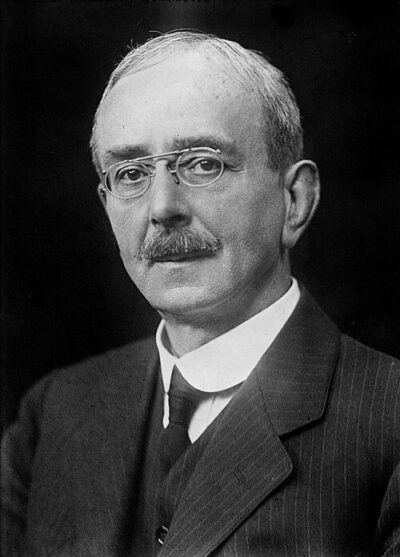
Charles Scott Sherrington
Charles Scott Sherrington was an English footballer, neurophysiologist and Nobel Prize recipient. Born November 27, 1857, in London. Died March 4, 1952, in Eastbourne. Positions held include President of the Royal Society (1920–1925). Educated at Fitzwilliam College and Gonville and Caius College. Awards include Knight Grand Cross of the Order of the British Empire, Order of Merit and Croonian Medal and Lecture.
Facts
51 facts · 2 confirmed by two sources · 16 cited · 33 from one source
Where this comes from
Papalocal keeps its own record. It started from these sources; what each one said is kept here as it was copied, so a change on their side never changes this page by itself. Tap one to read its version.
What Wikidata says · copied November 13, 2026 · revision 2568741984
- Described as
- English footballer, neurophysiologist and Nobel Prize recipient (1857–1952)
- Other names
- Sir Charles Scott Sherrington, Sir Charles Sherrington, Scott Sherrington
- Born
- November 27, 1857 · 10 references
- Died
- March 4, 1952 · 12 references
- Born in
- London · 1 reference
- Died in
- Eastbourne · 1 reference
- Buried in
- Ipswich
- Citizen of
- United Kingdom; United States
- Occupation
- physician; neurologist; university teacher; pathologist; physiologist · 2 references; association football player; naturalist · 1 reference
- Positions held
- President of the Royal Society (1920–1925) · 1 reference
- Worked for
- Magdalen College; University of Liverpool; King's College London
- Education
- Fitzwilliam College; Gonville and Caius College; Ipswich School; University of Oxford · 1 reference; St Thomas's Hospital Medical School
- Member of
- German Academy of Sciences Leopoldina (1925–) · 1 reference; Royal Society of London; Royal Swedish Academy of Sciences; Pontifical Academy of Sciences (1936–) · 1 reference; American Academy of Arts and Sciences (1918–) · 1 reference; Russian Academy of Sciences (1915–) · 1 reference; Accademia Nazionale delle Scienze detta dei XL; National Academy of Sciences (1924–) · 1 reference; Academy of Sciences of Turin (1922–) · 1 reference; Göttingen Academy of Sciences and Humanities in Lower Saxony (1906–) · 1 reference
- Teams
- Ipswich Town F.C.
- Sport
- association football
- Awards
- Knight Grand Cross of the Order of the British Empire; Order of Merit; Croonian Medal and Lecture (1897); Baly Medal (1899); Silliman Memorial Lectures (1904); Royal Medal (1905); Copley Medal (1927) · 1 reference; honorary doctorate from the University of Strasbourg (1927) · 2 references; doctor honoris causa from the University of Paris (1928) · 1 reference; Nobel Prize in Physiology or Medicine (1932) · 2 references; doctor honoris causa from the University of Lyon (1946) · 1 reference
- Field
- neurobiology; physiology; histology; bacteriology; pathology
- Wikipedias with a page
- 69
Wikidata item Q213504 (wikidata.org/wiki/Q213504), public domain (CC0). Copied November 13, 2026.
What Wikipedia says · copied November 13, 2026 · revision 1380449880
Sir Charles Scott Sherrington (27 November 1857 – 4 March 1952) was a British neurophysiologist and academic. His experimental research established many aspects of contemporary neuroscience, including the concept of the spinal reflex as a system involving connected neurons (the "neuron doctrine"), and how signal transmission between neurons can be potentiated or depotentiated. Sherrington himself coined the word "synapse" to define the connection between two neurons. His book The Integrative Action of the Nervous System (1906) is a synthesis of this work, in recognition of which he was awarded the Nobel Prize in Physiology or Medicine in 1932 (along with Edgar Adrian).
In addition to his work in physiology, Sherrington did research in histology, bacteriology, and pathology. He was president of the Royal Society in the early 1920s.
- Born, in its opening lines
- November 27, 1857
- Died, in its opening lines
- March 4, 1952
From the Wikipedia article “Charles Scott Sherrington” (en.wikipedia.org/wiki/Charles_Scott_Sherrington), by its contributors, under CC BY-SA 4.0 (creativecommons.org/licenses/by-sa/4.0/). Copied November 13, 2026; not changed.
Confirmed Two sources agree. Cited One source, and it names where it got it. One source One source, without a reference of its own. Sources disagree The sources disagree. We show the best-supported value and keep theirs below.
